TI-RADS Levels TR1 To TR5: FNA And Follow-Up Size Thresholds
What each ACR TI-RADS level means, the size at which FNA and follow-up are recommended, the follow-up schedule and how to define significant growth.
The ACR TI-RADS point total tells you how suspicious a thyroid nodule looks. What to do about it depends on a second variable: size. This article summarizes the thresholds for each level and the reasoning behind them.
The Thresholds At A Glance
| Level | Points | Category | FNA If | Follow-Up If |
|---|---|---|---|---|
| TR1 | 0 | Benign | Never | Never |
| TR2 | 2 | Not suspicious | Never | Never |
| TR3 | 3 | Mildly suspicious | 2.5 cm or larger | 1.5 cm or larger |
| TR4 | 4 to 6 | Moderately suspicious | 1.5 cm or larger | 1.0 cm or larger |
| TR5 | 7 or more | Highly suspicious | 1.0 cm or larger | 0.5 cm or larger |
Size means the maximum diameter of the nodule in any plane.
A nodule that is smaller than its follow-up threshold needs no further imaging under ACR TI-RADS. A nodule between the two thresholds is followed. A nodule at or above the FNA threshold is recommended for biopsy.
What Each Level Means
TR1: Benign
Zero points. These are typically purely cystic or spongiform nodules. The estimated malignancy risk is very low, about 2% or less in the white paper’s framework and well under 1% in several validation studies. No FNA, no follow-up.
TR2: Not Suspicious
Two points. A common example is a mixed cystic and solid nodule with an isoechoic solid component. The risk is again about 2% or less. No FNA, no follow-up.
TR3: Mildly Suspicious
Three points, for example a solid isoechoic nodule with smooth margins. The risk is about 5%. FNA at 2.5 cm or larger, follow-up at 1.5 cm or larger.
TR4: Moderately Suspicious
Four to six points, for example a solid hypoechoic nodule. The risk is in the range of 5% to 20%. FNA at 1.5 cm or larger, follow-up at 1.0 cm or larger.
TR5: Highly Suspicious
Seven points or more. These nodules combine several suspicious features, such as a solid, very hypoechoic nodule with punctate echogenic foci. The risk is at least 20%. FNA at 1.0 cm or larger, follow-up at 0.5 cm or larger.
Why The FNA Thresholds Are Higher Than In Other Systems
The ACR committee made a deliberate trade-off. Most thyroid cancers found in small nodules are indolent papillary carcinomas, and diagnosing every one of them does not clearly improve outcomes. Biopsy has costs too: indeterminate cytology, repeat procedures, diagnostic surgery and patient anxiety.
ACR TI-RADS therefore accepts that some small cancers will not be biopsied right away and relies on follow-up to catch the ones that grow. In return, it avoids a large number of biopsies of benign nodules. Comparative studies have consistently shown that ACR TI-RADS recommends fewer biopsies than other major systems, with a higher specificity. For the comparison, see ACR TI-RADS vs ATA vs EU-TIRADS.
Follow-Up Schedule
| Level | Suggested Follow-Up Ultrasound |
|---|---|
| TR3 | 1, 3 and 5 years |
| TR4 | 1, 2, 3 and 5 years |
| TR5 | Every year for up to 5 years |
Follow-up can stop at 5 years if the nodule has not changed, because stability over that period indicates benign behavior. If the nodule’s TI-RADS level increases during follow-up, reassess it against the thresholds for its new level.
Defining Significant Growth
Small differences in measurement are expected between examinations and between operators. ACR TI-RADS defines significant enlargement as either of the following:
- A 20% increase in at least two dimensions, with a minimum increase of 2 mm
- A 50% or greater increase in volume
Compare the current study with the oldest available examination, not only the most recent one. Slow growth can hide when each study is compared only with its immediate predecessor.
Multiple Nodules
In a multinodular gland, score each nodule on its own features. Do not pick the largest nodule by default: the dominant nodule is not necessarily the most suspicious. The ACR recommends:
- Reporting in detail up to four nodules, those with the highest point totals
- Targeting no more than two nodules for FNA, those with the highest point totals that meet the size criteria
When The Thresholds Do Not Apply
The thresholds are guidance for incidental and routinely detected nodules in adults. Clinical context can change the plan:
- Suspicious cervical lymph nodes. Biopsy of the node, and of the most suspicious ipsilateral nodule, is appropriate regardless of the nodule’s score.
- TR5 nodules of 5 to 9 mm. These are followed rather than biopsied by default, but FNA may be reasonable depending on location (for example next to the trachea or the recurrent laryngeal nerve) and the preference of the referring physician and patient.
- High-risk patients. A history of neck irradiation in childhood or a familial thyroid cancer syndrome may justify a lower threshold.
- Children. ACR TI-RADS was developed for adults. Pediatric nodules carry a higher malignancy rate and are managed under different guidance.
Try It
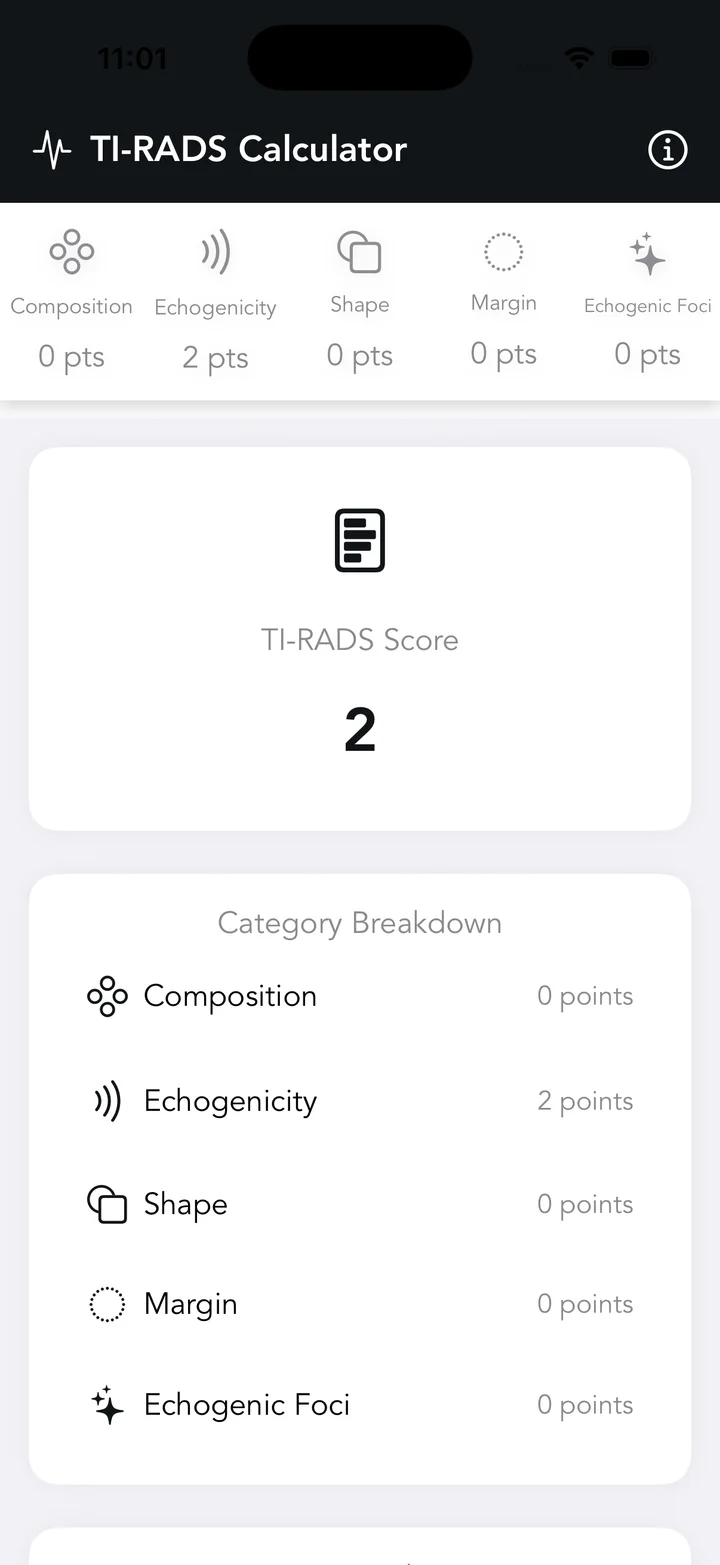
The TI-RADS calculator applies these thresholds automatically: enter the features and the maximum diameter, and it tells you whether the nodule falls in the FNA, follow-up or no-action range.
Reference
Tessler FN, Middleton WD, Grant EG, et al. ACR Thyroid Imaging, Reporting and Data System (TI-RADS): White Paper of the ACR TI-RADS Committee. J Am Coll Radiol. 2017;14(5):587-595. doi:10.1016/j.jacr.2017.01.046
Score A Nodule NowFree ACR TI-RADS calculator with example images.
Open The Calculator