ACR TI-RADS Scoring Explained: A Step-By-Step Guide
How ACR TI-RADS scores a thyroid nodule: the five ultrasound categories, the point values, the TR1 to TR5 levels and two worked examples.
Thyroid nodules are extremely common. Depending on the population and the ultrasound equipment, they are found in up to two thirds of adults, and the large majority are benign. The practical problem is not finding nodules but deciding which ones deserve a needle. ACR TI-RADS was designed for exactly that decision.
What ACR TI-RADS Is
ACR TI-RADS (Thyroid Imaging Reporting and Data System) is a risk stratification system published by the American College of Radiology in 2017. It builds on an earlier lexicon paper that standardized the terms used to describe nodules on ultrasound. The system has two parts:
- A point-based score from five ultrasound categories, which places the nodule in a level from TR1 to TR5.
- Size thresholds for each level that tell you when to recommend fine-needle aspiration (FNA) and when to recommend follow-up ultrasound.
Unlike pattern-based systems, every nodule can be classified. You never end up with a nodule that fits no pattern.
The Five Categories
Choose one feature in each of the first four categories. In the fifth category, echogenic foci, choose every feature that is present.
1. Composition
| Feature | Points |
|---|---|
| Cystic or almost completely cystic | 0 |
| Spongiform | 0 |
| Mixed cystic and solid | 1 |
| Solid or almost completely solid | 2 |
A spongiform nodule is composed mostly (more than 50%) of tiny cystic spaces. It is benign by definition: assign 0 points and do not add points from the other categories. If composition cannot be determined because of calcification, assign 2 points.
2. Echogenicity
| Feature | Points |
|---|---|
| Anechoic | 0 |
| Hyperechoic or isoechoic | 1 |
| Hypoechoic | 2 |
| Very hypoechoic | 3 |
Compare the solid part of the nodule with the adjacent thyroid parenchyma. Very hypoechoic means darker than the neck strap muscles. Anechoic applies to cystic or almost completely cystic nodules. If echogenicity cannot be determined, assign 1 point.
3. Shape
| Feature | Points |
|---|---|
| Wider-than-tall | 0 |
| Taller-than-wide | 3 |
Assess shape on a transverse image. A nodule is taller-than-wide when its anteroposterior diameter is greater than its transverse diameter. This feature is not very sensitive, but it is highly specific for malignancy, which is why it carries 3 points on its own.
4. Margin
| Feature | Points |
|---|---|
| Smooth | 0 |
| Ill-defined | 0 |
| Lobulated or irregular | 2 |
| Extra-thyroidal extension | 3 |
Note that an ill-defined margin scores 0. A border that is merely hard to see is not the same as a border that is spiculated, jagged or lobulated. If the margin cannot be determined, assign 0 points.
5. Echogenic Foci
| Feature | Points |
|---|---|
| None or large comet-tail artifacts | 0 |
| Macrocalcifications | 1 |
| Peripheral (rim) calcifications | 2 |
| Punctate echogenic foci | 3 |
This is the only additive category. A nodule with both macrocalcifications and punctate echogenic foci receives 1 + 3 = 4 points here. For details, see echogenic foci in thyroid nodules.
From Points To TR Level
| Total Points | Level | Category |
|---|---|---|
| 0 | TR1 | Benign |
| 2 | TR2 | Not suspicious |
| 3 | TR3 | Mildly suspicious |
| 4 to 6 | TR4 | Moderately suspicious |
| 7 or more | TR5 | Highly suspicious |
A total of exactly 1 point is rare and is generally managed as TR1. The management of TR1 and TR2 is identical anyway: no FNA, no follow-up.
Each level then has its own size thresholds, covered in detail in TI-RADS levels and FNA thresholds.
Worked Example 1: A Common Benign-Looking Nodule
A 2.0 cm nodule is solid, isoechoic, wider-than-tall, with a smooth margin and no echogenic foci.
- Composition, solid: 2
- Echogenicity, isoechoic: 1
- Shape, wider-than-tall: 0
- Margin, smooth: 0
- Echogenic foci, none: 0
Total: 3 points, TR3. The FNA threshold for TR3 is 2.5 cm and the follow-up threshold is 1.5 cm. At 2.0 cm, this nodule is followed with ultrasound at 1, 3 and 5 years rather than biopsied.
Worked Example 2: A Suspicious Nodule
A 1.1 cm nodule is solid, very hypoechoic, taller-than-wide, with an irregular margin and punctate echogenic foci.
- Composition, solid: 2
- Echogenicity, very hypoechoic: 3
- Shape, taller-than-wide: 3
- Margin, irregular: 2
- Echogenic foci, punctate: 3
Total: 13 points, TR5. The FNA threshold for TR5 is 1.0 cm, so FNA is recommended.
Practical Tips
- Measure consistently. Size thresholds use the maximum diameter. Measure the nodule in three planes and include the halo if one is present.
- Score the solid component. In a mixed nodule, echogenicity refers to the solid part.
- Report the features, not only the level. A structured description lets the next reader verify the score and compare over time.
- Limit the number of biopsies. The ACR recommends targeting no more than two nodules, those with the highest point totals that meet FNA criteria.
Reference
Tessler FN, Middleton WD, Grant EG, et al. ACR Thyroid Imaging, Reporting and Data System (TI-RADS): White Paper of the ACR TI-RADS Committee. J Am Coll Radiol. 2017;14(5):587-595. doi:10.1016/j.jacr.2017.01.046
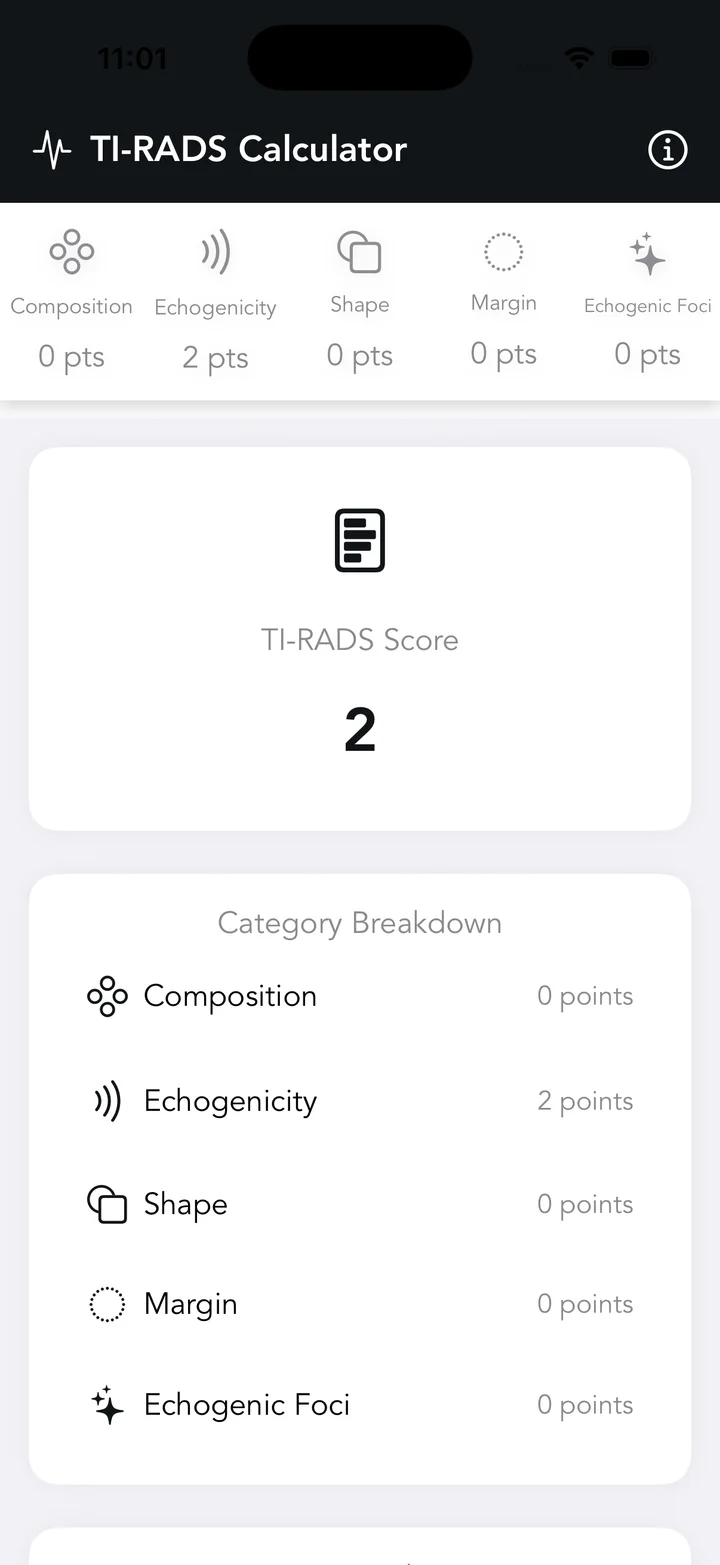
Score A Nodule NowFree ACR TI-RADS calculator with example images.
Open The Calculator