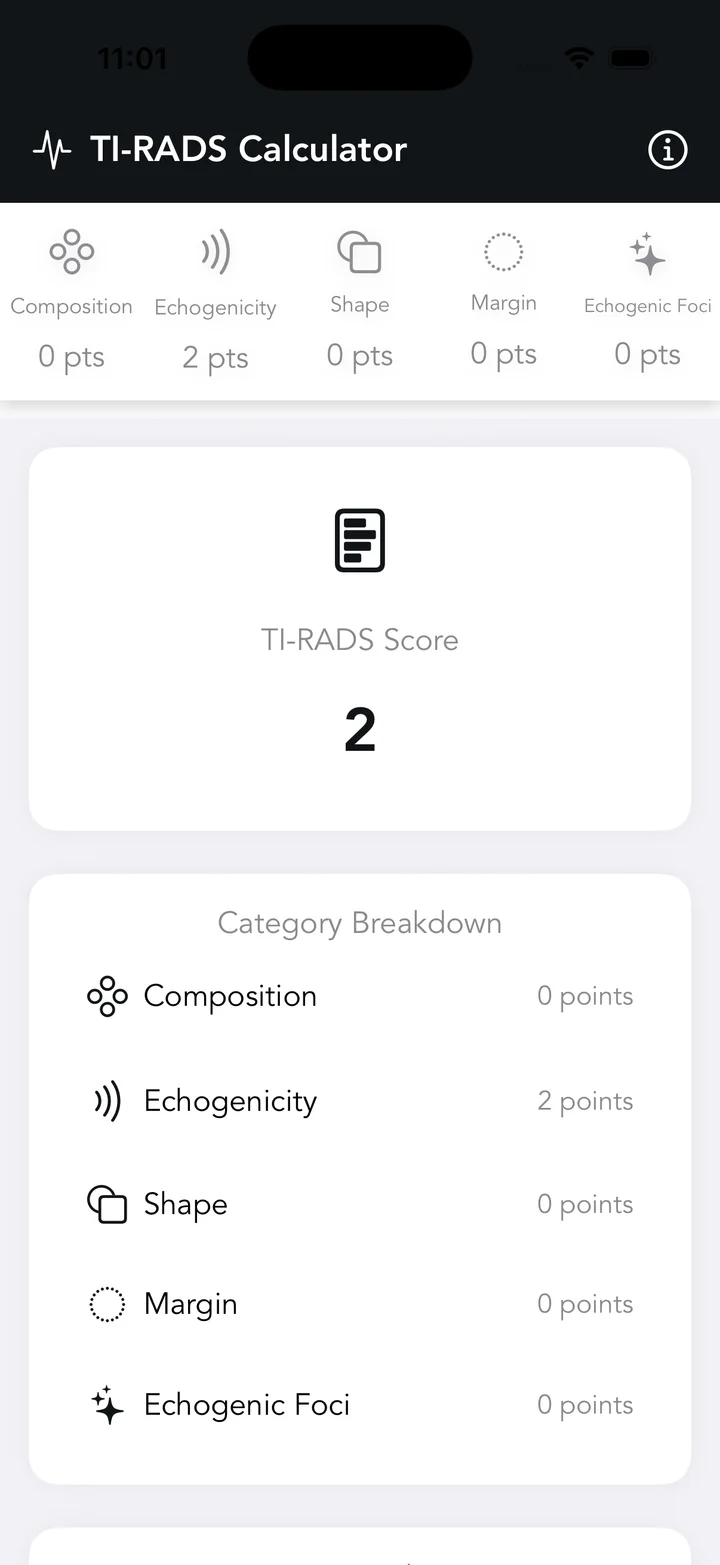
ACR TI-RADS Calculator
A free online TIRADS score calculator for thyroid nodules on ultrasound. Select the features and the score, TI-RADS level and recommendation update instantly. Tap any example image to enlarge it.
How To Use The TI-RADS Calculator
- Composition, echogenicity, shape, margin: choose the single best option in each category.
- Echogenic foci: choose every type that is present. Their points are added together.
- Size: enter the maximum diameter of the nodule in cm or mm.
- Result: read the point total, TR level and whether FNA or follow-up is recommended, then copy the report text.
ACR TI-RADS Point Chart
| Category | Feature | Points |
|---|---|---|
| Composition | Cystic or almost completely cystic | 0 |
| Spongiform | 0 | |
| Mixed cystic and solid | 1 | |
| Solid or almost completely solid | 2 | |
| Cannot be determined (calcification) | 2 | |
| Echogenicity | Anechoic | 0 |
| Hyperechoic or isoechoic | 1 | |
| Hypoechoic | 2 | |
| Very hypoechoic | 3 | |
| Cannot be determined (calcification) | 1 | |
| Shape | Wider-than-tall | 0 |
| Taller-than-wide | 3 | |
| Margin | Smooth | 0 |
| Ill-defined | 0 | |
| Lobulated or irregular | 2 | |
| Extra-thyroidal extension | 3 | |
| Echogenic Foci choose all that apply | None or large comet-tail artifacts | 0 |
| Macrocalcifications | 1 | |
| Peripheral (rim) calcifications | 2 | |
| Punctate echogenic foci | 3 |
TI-RADS Levels And Recommendations
| Level | Points | Category | Malignancy Risk | FNA | Follow-Up |
|---|---|---|---|---|---|
| TR1 | 0 points | Benign | About 2% or less | No FNA | No follow-up |
| TR2 | 2 points | Not Suspicious | About 2% or less | No FNA | No follow-up |
| TR3 | 3 points | Mildly Suspicious | About 5% | FNA if ≥ 2.5 cm | Follow-up if ≥ 1.5 cm: ultrasound at 1, 3 and 5 years |
| TR4 | 4 to 6 points | Moderately Suspicious | 5% to 20% | FNA if ≥ 1.5 cm | Follow-up if ≥ 1.0 cm: ultrasound at 1, 2, 3 and 5 years |
| TR5 | 7 points or more | Highly Suspicious | At least 20% | FNA if ≥ 1.0 cm | Follow-up if ≥ 0.5 cm: ultrasound every year for up to 5 years |
Source: Tessler FN, Middleton WD, Grant EG, et al. ACR Thyroid Imaging, Reporting and Data System (TI-RADS): White Paper of the ACR TI-RADS Committee. J Am Coll Radiol. 2017;14(5):587-595. doi:10.1016/j.jacr.2017.01.046
Questions About Scoring
How is the TI-RADS score calculated?
Pick one option in each of the first four categories (composition 0 to 2 points, echogenicity 0 to 3, shape 0 or 3, margin 0 to 3) and all that apply for echogenic foci (0 to 3 each, added together). Add the points. 0 points is TR1, 2 points is TR2, 3 points is TR3, 4 to 6 points is TR4 and 7 or more points is TR5.
When is FNA recommended?
FNA is recommended for TR3 nodules of 2.5 cm or larger, TR4 nodules of 1.5 cm or larger and TR5 nodules of 1.0 cm or larger, measured by maximum diameter. TR1 and TR2 nodules do not need FNA at any size.
When is ultrasound follow-up recommended?
Follow-up is recommended for TR3 nodules of 1.5 cm or larger (at 1, 3 and 5 years), TR4 nodules of 1.0 cm or larger (at 1, 2, 3 and 5 years) and TR5 nodules of 0.5 cm or larger (every year for up to 5 years). Follow-up can stop after 5 years if the nodule is stable.
Why does a spongiform nodule score 0 points?
A spongiform nodule, made of tiny cystic spaces in more than half of its volume, is considered benign. ACR TI-RADS assigns it 0 points for composition and no further points are added for the other categories, so it is always TR1.
What does a score of 1 point mean?
The ACR chart lists 0 points as TR1 and 2 points as TR2. A total of exactly 1 point is uncommon and is generally grouped with TR1, which is how this calculator handles it. Management is the same for TR1 and TR2: no FNA and no follow-up.
Want the full walkthrough? Read ACR TI-RADS scoring explained.
Prefer A Native App?
Easy TI-RADS Calculator brings the same scoring to iPhone and iPad with a guided step-by-step flow, built-in example nodules and full offline access.
- Guided five-step scoring
- Example ultrasound images for every feature
- Works offline, on iPhone and iPad
 Scan To
Download