Thyroid FNA Biopsy: Indications, Technique And Results
A practical guide to ultrasound-guided thyroid fine-needle aspiration: which nodules to biopsy by TI-RADS, needle and technique, complications and the Bethesda categories.
Ultrasound-guided fine-needle aspiration (FNA) is the step that follows a suspicious TI-RADS score. It is quick, safe and inexpensive, and it is the main tool for deciding which thyroid nodules need surgery. This guide covers the questions that come up in daily practice: which nodule, how to do it, what can go wrong and how to read the result.
This article is based on articles retrieved from PubMed. It describes common practice and published evidence and does not replace local protocols.
Which Nodules Need FNA
Under ACR TI-RADS, the decision depends on the level and the maximum diameter:
| Level | FNA If |
|---|---|
| TR1, TR2 | No FNA |
| TR3 | 2.5 cm or larger |
| TR4 | 1.5 cm or larger |
| TR5 | 1.0 cm or larger |
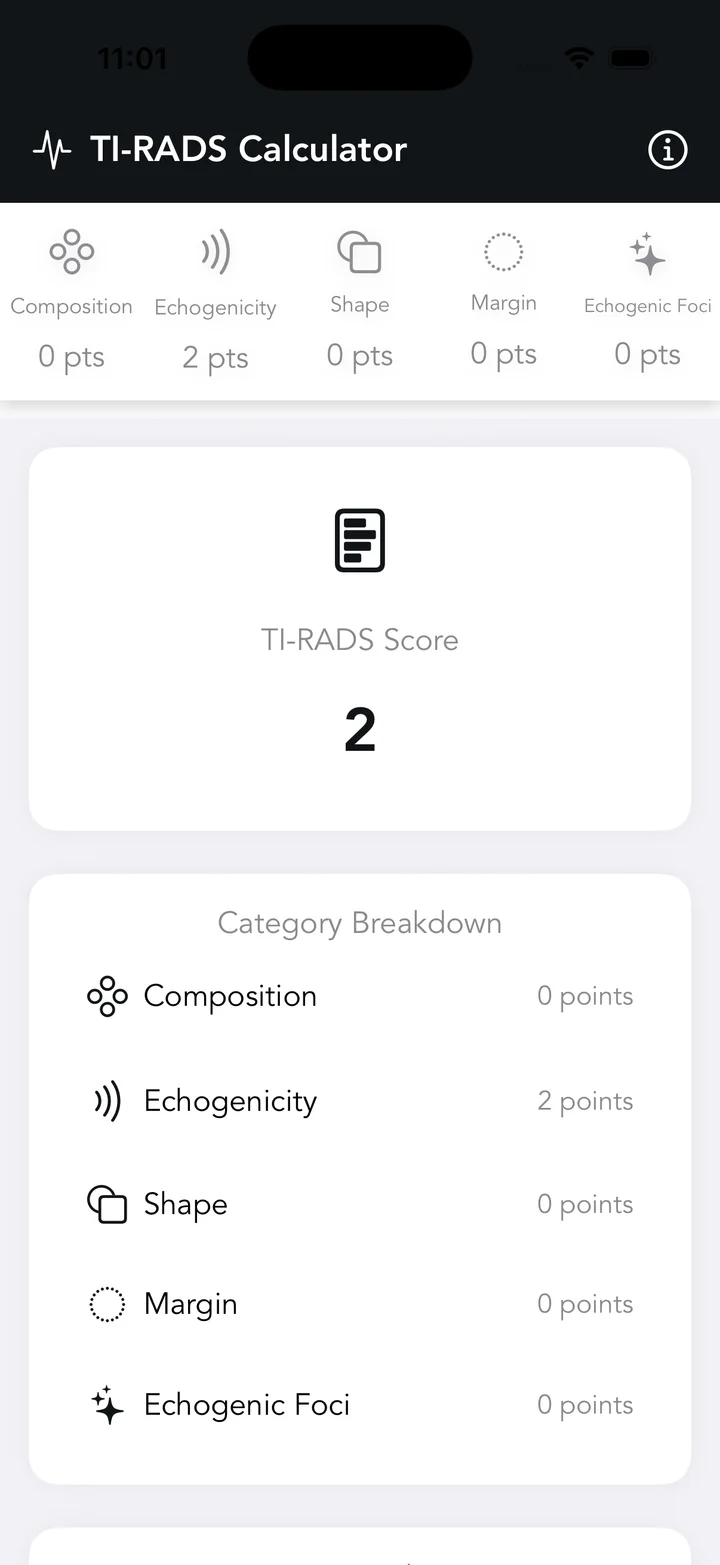
You can check any nodule against these thresholds with the TI-RADS calculator. The reasoning behind the numbers is explained in TI-RADS levels and FNA thresholds.
Three rules for choosing the target:
- Choose by suspicion, not size. In a multinodular gland, biopsy the nodules with the highest point totals that meet their size threshold, and no more than two.
- Look at the neck nodes. A suspicious cervical lymph node should be sampled, along with the most suspicious nodule on the same side, whatever the nodule’s score.
- Aim for the right part of the nodule. In a mixed nodule, target the solid component, especially any area with suspicious features. Avoid purely cystic or necrotic areas, which mainly yield fluid.
Before The Procedure
Consent And Explanation
Tell the patient what to expect: a few needle passes, a few seconds each, with mild pressure or brief pain. Most patients report no or mild discomfort. Ask them not to swallow or talk while the needle is in place.
Anticoagulants And Antiplatelet Drugs
Thyroid FNA with a thin needle is generally treated as a low bleeding risk procedure, and many centers perform it without stopping anticoagulants or antiplatelet drugs. One study of 438 patients found no significant difference in the non-diagnostic rate between patients on aspirin, warfarin or clopidogrel and those off these drugs (3.9% vs 2.3%), and concluded that stopping medication is not necessary to obtain sufficient material. That study measured sample quality, not bleeding, so follow your institution’s periprocedural policy, particularly for patients on combined therapy or with a known coagulopathy.
Local Anesthesia
Practice varies. Some operators inject a small amount of local anesthetic in the skin, others use none because the anesthetic injection is itself a needle pass. Either is acceptable.
Technique
Needle Size
Thin needles work well. A meta-analysis of 24 studies and 4,428 nodules found a trend in favor of smaller needles and recommended performing FNA with 24 to 27 gauge needles. A more recent meta-analysis of 16 studies found no significant difference in sample adequacy between larger and smaller gauges. Since thinner needles are more comfortable and cause less bleeding into the sample, 25 or 27 gauge is a sensible default.
Aspiration Or Capillary Technique
There are two ways to collect cells:
- Capillary (non-aspiration) technique: the needle is moved back and forth within the nodule without suction, and cells enter by capillary action.
- Aspiration technique: suction is applied with a syringe during the passes.
In the meta-analysis above, the capillary technique significantly reduced non-diagnostic cytology (relative risk 0.57). It tends to produce less blood in the sample, which matters in a vascular organ. Suction remains useful for draining fluid from cystic nodules and for fibrotic or calcified nodules that yield little material.
Approach And Number Of Passes
Use continuous ultrasound guidance and keep the needle tip visible. Both the parallel (in-plane) and perpendicular (out-of-plane) approaches work; the parallel approach shows the whole needle. Move the needle quickly through different parts of the nodule for a few seconds per pass.
There is no firm evidence for an ideal number of passes. Most operators take two to five, depending on the nodule and on whether a cytologist assesses adequacy on site.
After The Procedure
Apply firm pressure for several minutes and check the site with ultrasound before the patient leaves if there is pain or swelling. Patients can resume normal activity the same day.
Complications
A systematic review of 23 cohort studies summarizes the risks:
- Most patients have no or mild discomfort.
- Hematoma or hemorrhage was reported in 0% to 6.4% of patients across studies. Most are small and resolve with compression.
- Vasovagal reaction, vocal cord palsy and tracheal puncture are rare.
- Needle tract implantation of tumor is very rare (0.02% to 0.19%).
Serious complications are exceptional. A rapidly enlarging hematoma with breathing difficulty is the one to recognize early.
Reading The Result: The Bethesda System
Cytology is reported with the Bethesda System for Reporting Thyroid Cytopathology. The 2023 edition assigns one name to each of six categories and gives an average risk of malignancy (ROM) for each.
| Category | Name | Average ROM (Range) | Usual Management |
|---|---|---|---|
| I | Nondiagnostic | 13% (5 to 20%) | Repeat FNA with ultrasound guidance |
| II | Benign | 4% (2 to 7%) | Clinical and ultrasound follow-up |
| III | Atypia of undetermined significance (AUS) | 22% (13 to 30%) | Repeat FNA, molecular testing, diagnostic lobectomy or surveillance |
| IV | Follicular neoplasm | 30% (23 to 34%) | Molecular testing or diagnostic lobectomy |
| V | Suspicious for malignancy | 74% (67 to 83%) | Molecular testing, lobectomy or near-total thyroidectomy |
| VI | Malignant | 97% (97 to 100%) | Lobectomy or near-total thyroidectomy |
What changed in 2023:
- One name per category. Older alternative terms such as “unsatisfactory” and “follicular lesion of undetermined significance” were dropped.
- AUS is split into two subgroups, based on the implied risk and molecular profile.
- Pediatric risks and management were added.
- Terminology was aligned with the 2022 WHO classification, and chapters on molecular testing and on clinical and imaging perspectives were added.
When Cytology And Imaging Disagree
A benign result in a TR5 nodule should not end the workup. Sampling error happens, and the ultrasound appearance carries its own weight. Discordant cases deserve a repeat FNA or closer follow-up. The reverse also applies: a low-suspicion nodule with benign cytology can be followed with confidence.
The Nondiagnostic Or Indeterminate Result
Nondiagnostic (Bethesda I)
The first step is usually a repeat ultrasound-guided FNA. If the repeat is again inadequate, core needle biopsy is an option. In a meta-analysis of 1,028 nodules with an initially non-diagnostic FNA, the non-diagnostic rate was 6.4% for core needle biopsy and 36.5% for repeat FNA, with higher sensitivity (89.8% vs 60.6%) and no major complications. Core biopsy is regarded as a complementary method in experienced hands, not a replacement for first-line FNA.
Indeterminate (Bethesda III And IV)
These categories are where molecular testing has changed practice. A 2025 meta-analysis of 31 studies and 4,464 Bethesda III and IV nodules found that molecular tests allowed surgery to be avoided in roughly half to two thirds of cases, depending on the test. Where molecular testing is not available, the options are repeat FNA, diagnostic lobectomy or surveillance, guided by the ultrasound pattern and patient preference.
Other Uses Of FNA
- Lymph nodes. FNA of a suspicious cervical node, often with thyroglobulin measurement in the needle washout, helps confirm metastatic thyroid cancer.
- Cyst drainage. Symptomatic cysts can be aspirated, although many recur. Ethanol ablation is described as the most effective and least expensive treatment for cystic nodules.
- Before thermal ablation. Radiofrequency and other thermal ablation techniques are restricted to benign nodules that cause symptoms or cosmetic concern, so benign cytology must be established before treatment. Check the ablation guideline you follow for the number of benign samples it requires.
Key Points
- TI-RADS level plus size decides who gets FNA; suspicion beats size when choosing targets.
- Thin needle, capillary technique, continuous ultrasound guidance.
- Complications are uncommon and mostly minor.
- Report and read results by the 2023 Bethesda categories.
- Imaging and cytology should agree. If they do not, do more.
References
- Tessler FN, Middleton WD, Grant EG, et al. ACR Thyroid Imaging, Reporting and Data System (TI-RADS): White Paper of the ACR TI-RADS Committee. J Am Coll Radiol. 2017;14(5):587-595. doi:10.1016/j.jacr.2017.01.046
- Ali SZ, Baloch ZW, Cochand-Priollet B, et al. The 2023 Bethesda System for Reporting Thyroid Cytopathology. Thyroid. 2023;33(9):1039-1044. doi:10.1089/thy.2023.0141
- Moss WJ, Finegersh A, Pang J, et al. Thyroid. 2018;28(7):857-863. doi:10.1089/thy.2017.0643
- Mohebbi A, Abdi A, Mohammadzadeh S, et al. Acad Radiol. 2025;32(12):7309-7319. doi:10.1016/j.acra.2025.08.022
- Park JY, Choi W, Hong AR, et al. Endocrinol Metab (Seoul). 2023;38(1):104-116. doi:10.3803/EnM.2023.1669
- Denham SL, Ismail A, Bolus DN, Lockhart ME. J Ultrasound Med. 2016;35(1):43-48. doi:10.7863/ultra.15.03044
- Patel IJ, Rahim S, Davidson JC, et al. Society of Interventional Radiology consensus guidelines on periprocedural bleeding risk. J Vasc Interv Radiol. 2019;30(8):1168-1184.e1. doi:10.1016/j.jvir.2019.04.017
- Lee YH, Baek JH, Jung SL, et al. Korean Society of Thyroid Radiology consensus statement on thyroid FNA. Korean J Radiol. 2015;16(2):391-401. doi:10.3348/kjr.2015.16.2.391
- Suh CH, Baek JH, Kim KW, et al. Endocr Pract. 2016;22(6):679-688. doi:10.4158/EP15986.OR
- Na DG, Baek JH, Jung SL, et al. Korean Society of Thyroid Radiology consensus statement on core needle biopsy. Korean J Radiol. 2017;18(1):217-237. doi:10.3348/kjr.2017.18.1.217
- Chowdhury R, Hier J, Payne KE, et al. Cancers (Basel). 2025;17(7):1156. doi:10.3390/cancers17071156
- Papini E, Monpeyssen H, Frasoldati A, Hegedüs L. 2020 European Thyroid Association Clinical Practice Guideline for the Use of Image-Guided Ablation in Benign Thyroid Nodules. Eur Thyroid J. 2020;9(4):172-185. doi:10.1159/000508484
Score A Nodule NowFree ACR TI-RADS calculator with example images.
Open The Calculator